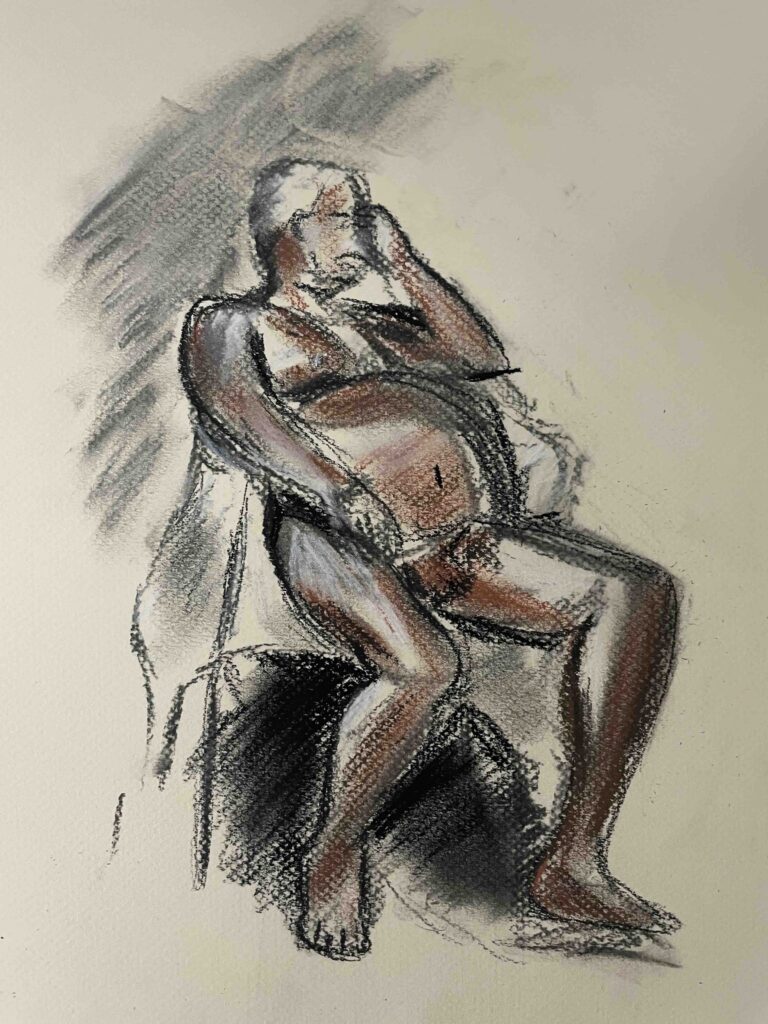
Everyone who told me my anti-depressants would kill my creativity lied. Well, maybe they didn’t lie. Maybe they were simply mistaken. Either way, the fact of the matter is that they were wrong.
Let me back up.
My life has been a series of cycles. I’d feel okay. Maybe even good for awhile. Then the days would begin to drag on until I was forcing myself through classes and other obligations. Sometime after that I’d begin crying weekly, then the tears would become more frequent until they occurred multiple times a day. There are periods in my life where I cried myself to sleep every single night.
Then I’d crash. I’d bawl my eyes out for 3, 4, 6+ hours. The next day, I’d be tired and I’d hit mental clarity. I’d get my energy back, I’d catch up and get ahead in school, I’d write thousands of words. And then, eventually, the days would begin to drag on.
I don’t remember when the cycles started. I remember months spent on the playground alone in late elementary school after I fought with my “best” friends. I remember consistently fighting the impulse to self-harm in middle school and lashing out at those who tried to befriend me because no matter who I had around, I felt alone. By high school the cycles and the self-hatred had worked themselves into my self-concept; they were a part of how I experienced my mind. I found a way to look at the crashes constructively – yes, they sucked, but I told myself that they were a way to constantly reevaluate whether what I was doing was working for me and a method of figuring out what I needed to change. In retrospect, sure, that’s a way to look at the bright side, but someone should have pointed out to me that if I hadn’t figured out how to live my life in such a way that I wasn’t regularly contemplating alternative uses of razors and electric tea kettles and losing hours to breakdowns after so many years, I wasn’t going to without changing my strategy.
Enter counseling.
I first remember seeing a counselor my junior or senior year of high school. I enjoyed talking to him; he accepted my eccentricities in stride and complimented me on how well I understood myself. I’m not convinced he ever really helped me, but he gave me a space to talk about myself for an extended period of time without making me feel like I was annoying him with it. For that, I was grateful.
I went to a small college first, and I’m pretty sure I saw all four of the counselors there at some point. I saw the one I was most comfortable with somewhat regularly for awhile during the fall semester. I was going through a cycle again and doing my very best to work myself out of it without medication. I made a list of things I was going to do to help myself. I wasn’t entirely opposed to medication, but I didn’t want it unless I found absolutely nothing else that worked. I stopped seeing him for a few months until I’d gone through another cycle and crashed again. That spring, I was told I had Bipolar II and put on medication for it because nothing else seemed to be working.
My first experience with medication was horrendous. Not only did the medication make my moods worse, I dealt with a huge degree of stigma and dismissal of my emotions from my family. Because I had a mood disorder and was medicated for it, they never took me seriously when I was upset. They never approached any problem as something for us to resolve – they told me to take my meds even when I had. So I stopped.
Then I transferred schools. I talked to another counselor regularly until he also determined that I needed medication and sent me to the psychiatrist, who didn’t give me a prescription. The next year, I felt myself on another down. The day I realized I was having trouble getting to class because I wasn’t sure I could handle the world, I had the foresight to start it once more.
The spiral was worse this time. I don’t know how much of it was due to schedule (I was taking the equivalent of 20 credit hours, working, trying to volunteer, and maintaining a social life, among other things), how much of it was other stressors (I went through my first break-up with a live-in partner of 3.5+ years, someone I’m very close to was/is still recovering from cancer, my job wasn’t quite covering my living expenses…), and how much of it was chemical.
I found myself unable to do any kind of work because the minute it was quiet enough to think I couldn’t focus on what I needed to do. Instead, I thought about everything the people I cared about most had done to hurt me. I convinced myself they didn’t actually care about me or that they were idiots for loving me and would eventually find something about me they’d leave me over. My mind told me I was worthless, an underachiever, that I’d never amount to anything. I shook and I cried and I feared the future. I couldn’t get any work done; the hours I’d set aside to do it were lost staring at the wall and forcing myself not to scratch my limbs hard enough to draw blood. I eventually gave up and began choosing Tumblr and Facebook over a few hours of self-hatred. I went to bed by 10:30pm so I wouldn’t stay up late enough to start thinking, because when that happened, I couldn’t get to sleep until at least 4. I started feeling sick constantly. My class and work attendance plummeted and I quit my volunteer position. I got continually further behind in school work, and every once in awhile I’d try to catch up only to be reminded why I stopped trying in the first place. I stopped shaving my legs because I didn’t trust myself with the razor. I failed a belt test for the first time since I did taekwondo as a child and didn’t bother testing the next time I had the option. I had intended to rewrite my novel this semester and I didn’t touch it. The little bit of writing I got done was either near the beginning of the semester while I could still deal with silence or in the form of short informal pieces I wrote through tears because I didn’t want to bother anyone with the same issues I’m always dealing with.
I broke. I realized I wasn’t going to be able to catch up on homework or rent, and I broke. At my next appointment, I made it five minutes in before I burst into tears. I was sent back to the psychiatrist and put on medication for major depression. I withdrew from classes so I wouldn’t have to take failing grades.
It’s hard not to be angry. I can’t tally up everything I feel was taken from me. I don’t know how many hours I’ve spent crying, hating myself, questioning the validity of my emotions, and fighting self-destructive tendencies over the years simply because of these cycles. I can’t quantify the damage done to my self-esteem, my relationships, or my productivity. I don’t know how much money I lost because I couldn’t get myself to work or how much I’m losing by taking another semester to make up for withdrawing from classes this spring.
There were varying reactions to the prescription. My mother told me she was on the same medication and it was working well for her. A close friend cringed when I told her the name. The most troubling reaction by far was that of my live-in ex-boyfriend: “You know it’s going to kill your creativity, right? You’re not going to be able to write.” He supposedly had second-hand knowledge; someone he is close to supposedly lost her drive toward music/creativity after being medicated for bipolar disorder. Of course, he’s not the only one who approached the loss of my creativity with that level of certainty.
I’ve heard it before. I’ve heard the rumors that medications change your fundamental personality, make you into a zombie, take away your creativity. They weren’t new to me. His account may be true – I have no way of knowing it. I do know there have been other accounts like it. I also know that without my writing and my art, I cease to feel alive.
At that point in time, though, there was an undeniable truth: I could not function at minimal capacity. Sure, it’s tempting to outsiders to suggest that the only reason I couldn’t do it was that I was “doing too much,” but I know that’s not true. It had nothing to do with the amount of obligations I had and everything to do with the fact that I could not keep it together for ten minutes of silence. Sure, I was partially skeptical that something as insignificant as a chemical could keep me from my passions, but mostly, I knew I wasn’t able to excel in them anyway because of my inability to focus, and I was willing to take the risk of losing some inspiration in order to attempt to function again. So I shrugged it off, filled my prescription, and started the pills.
This was two weeks ago. I’ve stopped panicking whenever I’m alone with my thoughts for too long. When I’m not with someone, my sleep schedule is back to normal and I don’t go to sleep shaking. My thoughts have stopped being scrambled and it’s significantly easier for me to trust my feelings and approach problems with a level head. And all of the space that used to be occupied by insecurities and worrying and self-depreciation has opened up… and has started to get filled by artistic inspiration.
The medication didn’t take away my creativity. It took away all of the bullshit that prevented it.
I’m not pretending my experience is universal. I’m sure the rumors have a basis in someone’s reality. What irks me isn’t that this is a possibility – what irks me is what seems to be a common belief that one cannot both take medication that makes them function in society as well as be a creative individual. What irks me is that it was framed as a choice: my art versus my mental health. What irks me is that, in my lowest moment, someone tried to tell me that taking the one thing that would give me the ability to be content and productive would take away one of the things most fundamental to my personality and happiness. What irks me is that people told me it WOULD do this without accounting for all of the cases in which a person takes a pill and is able to be content, productive, and artistic.
We need to stop pretending that all medication is the same. We need to stop pretending that all bodies reaction to every medication the same way. We need to stop perpetuating the myth that you cannot maintain your creativity unless you let your mental illness go untreated. Because it’s all blatantly wrong.
The medication didn’t steal my creativity. Depression did. The medication brought it back.